Koramangala, Koramangala 8th Block, Bangalore - South, Karnataka

Koramangala, Koramangala 8th Block, Bangalore - South, Karnataka
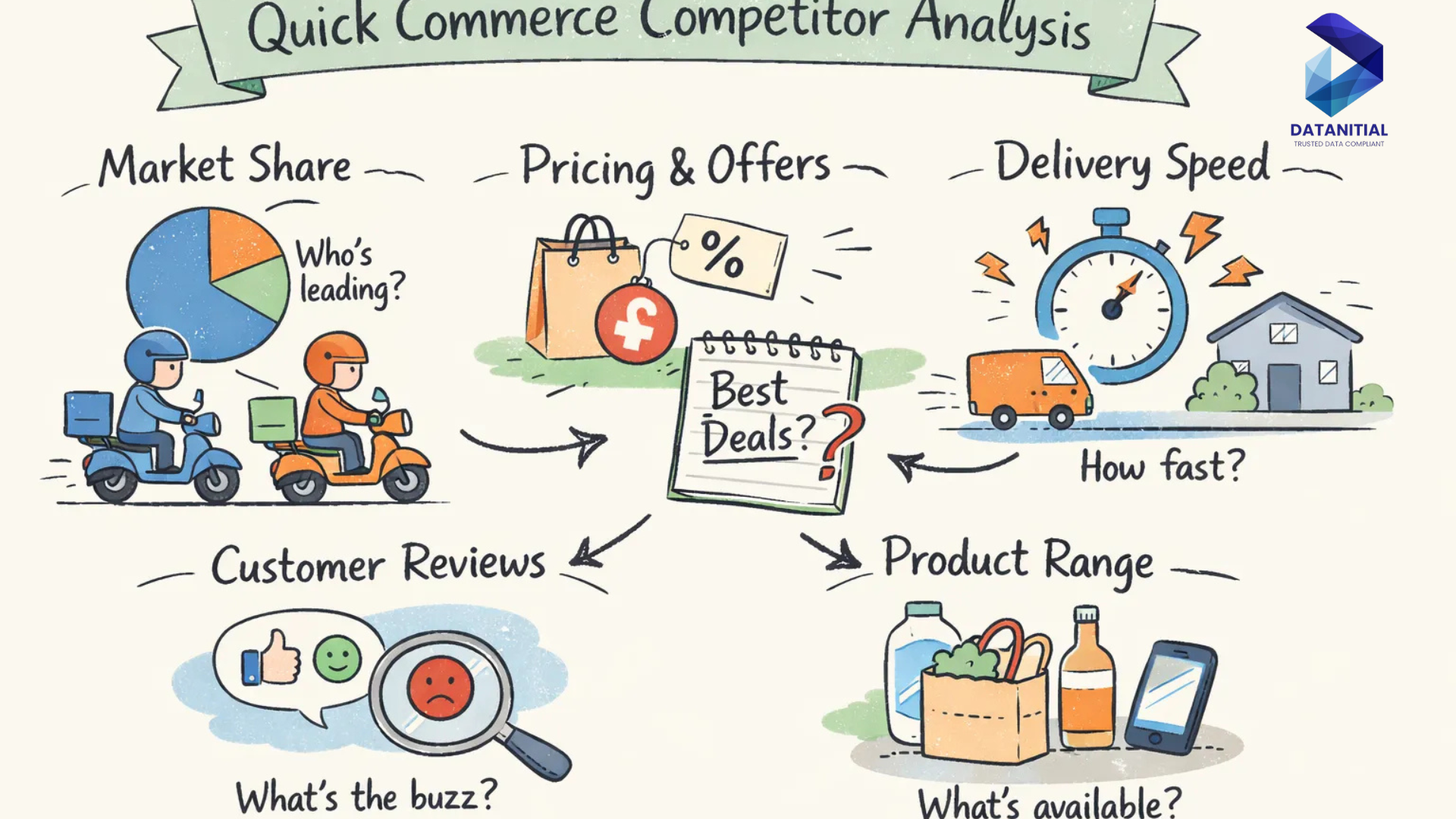
In 2026, quick commerce competition is no longer defined by speed alone. Sub-20-minute delivery has become standard in dense urban markets. What separates winners now is precision AI-driven pricing, hyperlocal inventory visibility, fulfillment reliability, and retention stability.
Weekly competitor reports are obsolete. Pricing shifts hourly. Promotions rotate by zone. Stock-outs vary by micro-fulfillment center. Delivery capacity fluctuates by time band. The competitive battlefield is real-time and hyperlocal.
Quick commerce competitor analysis in 2026 must therefore evolve from passive benchmarking to operational intelligence. Teams need synchronized visibility across pricing, inventory, delivery performance, customer retention, and conversion efficiency mapped directly to revenue, margin, and customer lifetime value.
This guide presents a 5-pillar framework supported by 12 revenue-critical KPIs that allow pricing, operations, and growth teams to move from observation to action hourly, not weekly.
Quick commerce dynamics have structurally changed. Five major shifts now define competitive advantage:
Competitor prices for hero SKUs now change multiple times per day in Tier-1 cities. Static price benchmarking is ineffective. Real-time price intelligence and elasticity modeling are mandatory.
Sub-20-minute expectations in dense markets are becoming standard. On-time rates below 92% now directly impact repeat purchase rates.
Customers no longer tolerate “listed but unavailable” items. Geo-level stock-outs on hero SKUs immediately reduce conversion and trust.
Frequent promotions may drive short-term spikes, but delivery consistency and substitution accuracy now have stronger correlation with repeat purchase rate and CLV.
Growth-at-all-costs models are fading. Competitive intelligence must quantify impact on margin, fulfillment cost, and lifetime value not just volume.
In 2026, quick commerce competitor analysis is not about gathering data. It is about triggering operational responses at the speed competitors move.
Price and promotions: Continuously track product, cart, and banner prices and set real-time alerts for tactical responses. These signals directly affect conversion and margin, so map alert thresholds to profit and conversion targets.
Inventory and assortment: Monitor on-shelf availability, stock-outs, and replenishment speed using geo-sampled checks to reduce lost sales. Track assortment gaps across store formats so merchandising and procurement can act on local shortages.
Delivery KPIs: Measure order-to-door time, picking time, slot capacity, and on-time rate against targets (for example, 10 to 30 minutes and 90%+ on-time) to benchmark the customer experience. Use these metrics to spot capacity shortfalls and prioritize routing or staffing changes.
Customer signals: Track average order value, repeat purchase rate, funnel conversion metrics, and review sentiment to assess demand strength and retention risk. Segment these signals by acquisition channel and delivery zones to find where service or price problems hurt loyalty.
Prioritize and act: Use a simple impact/cost rubric and run a seven-day pulse on top SKUs so pricing and ops teams can react hourly rather than weekly. Automate feeds and alerts to turn observed competitor moves into operational responses.
Pricing and promotions are the quickest visible signals competitors use to gain short-term volume. Capture list price, checkout price, and localized promo messaging by scraping product pages, cart prices, and store banners across geographies and time.
Choose sampling frequency based on volatility hourly for high-turn SKUs and hero slots, daily for stable grocery items. Always log timestamps, locations, and variant mappings since promotions can mask true unit prices when sellers swap SKUs or bundle items.
Record banner images, coupon codes, category-level promos, and in-app hero slots the same way you capture pricing. Measure promo depth as a percentage discount, track promo duration in hours or days, and record recurrence over rolling windows.
Combine depth and recurrence into an aggressiveness score to surface competitors that promote relentlessly and capture brief volume spikes.
Treat average order value and basket composition as outcome metrics that validate pricing and promo hypotheses. Estimate promo elasticity by correlating percentage changes in order volume and attach rates to measured promo intensity, then set AOV thresholds that trigger pricing interventions when baskets fall below profitability bands. Run quick experiments vary discount tiers and test bundles versus single-item promos—and measure attach-rate lift within 24 to 72 hours to validate assumptions.
Availability signals map directly to the customer experience and lost sales. Use geo-sampled product lookups, add-to-cart checks, and timed cart-to-checkout probes to determine whether an item is truly purchasable or only listed. Short, repeatable probes help separate transient glitches from persistent stock-outs, and rotating probe locations reveals local availability differences across stores and formats.
Simulate delivery radii at several bands - 1 km, 3 km, and 5 km and rotate stores by chain and format to surface shortages and assortment gaps. Standardize stock-out events with tags such as OUT_OF_STOCK, LOW_STOCK, LOCATION_RESTRICTED, and PRICE_MISMATCH so downstream analytics can group events reliably. Use these tags to power alerts and feed decision logic for temporary inventory reallocation or targeted promotions.
Inventory turnover matters in dark stores and micro-fulfillment centers because it links replenishment speed to waste and lost sales. Define turnover as sales over a period divided by average inventory, and correlate higher turnover with lower stock-out risk for fast movers. Sample inventory levels hourly for top SKUs during peak windows and daily for the remainder to balance accuracy and cost. Track hero SKUs to get an early read on category health by estimating the top N sales proxies and computing hero SKU share. For best practices on implementing real-time inventory management in quick commerce, review industry guidance on real-time inventory management for quick commerce.
Order-to-door, picking time, and fulfillment time form the core clocks you must measure. Order-to-door is the elapsed time from checkout confirmation to delivery, picking time is the shopper's assembly time, and fulfillment time covers backend preparation until handoff. Capture these events with app probes, timestamped checkouts, and rider scans to produce synchronized, auditable timelines. These considerations align with broader last-mile delivery trends and expectations that are reshaping fulfillment investments.
Combine user-facing times with operational proxies from dark-store inventory and slot availability to view both experience and capacity. Track promised window versus actual delivery to compute on-time rate, and poll slot inventory by time of day and by zone every 15 to 30 minutes during peak hours to map scarcity. Compare rolling 24-hour windows to detect persistent shortages and capacity stress.
Use operational proxies to generate alerts and prioritize fixes: investigate when on-time delivery slips below 90% or when late deliveries exceed 5% in a rolling hour. Monitor substitution-rate spikes and declining delivery density as early indicators of systemic pressure. Translate these fulfillment signals into revenue and retention impact so engineering and ops teams can focus on fixes that protect lifetime value.
Aggregate review volume, rating distribution, and sentiment across app stores, web pages, and in-app comments, and normalize by source and time window for fair comparison. Useful aggregates include reviews per week, the share of 4- to 5-star versus 1- to 2-star reviews, and a weighted average rating that gives recent reviews more weight. Normalizing by installs or visits prevents high-volume but low-conversion channels from skewing interpretation. For a broader reference on ecommerce metric definitions and how teams typically measure them, see this guide to ecommerce metrics.
Flag emerging quality or service issues by detecting shifts in both review volume and polarity. For example, a week-over-week 30% rise in negative reviews or a 0.3-point drop in average rating within seven days should trigger a root-cause check. Run keyword extraction on negative reviews to surface recurring themes like "delivery cold", "missing items", or "wrong substitution" and escalate when negative sentiment crosses preset thresholds.
Measure repeat purchase rate and estimate customer lifetime value with cohort windows suited to quick commerce: weekly cohorts capture rapid behavior while monthly cohorts show trend stability. Define repeat purchase rate as customers with more than one order in the period divided by unique customers in the period. A lightweight CLV estimate is CLV = AOV × purchase frequency per period × average lifespan in periods, and segmenting cohorts by delivery reliability reveals how operational failures depress retention.
For funnel health, capture product page views, add-to-cart, checkout initiation, and completed orders to calculate drop-off points and attach rates for hero SKUs. Sudden drops between view and add-to-cart often point to UX or pricing friction, while later drops indicate checkout, stock, or payment issues. Run rapid A/B checks on price parity, call-to-action wording, or visible stock flags, and validate suspected problems with mystery-shop orders before rolling changes to production.
Instrument a broad set of sources: competitor web storefronts, mobile app network traces, dark-store product pages, delivery partner listings, app store reviews, social signals, POS or partner feeds, and third-party data. Use scraping for high-volume public pages and network traces for in-app prices and cart behavior. Prefer partner APIs when available for reliability and lower compliance risk, and run mystery-shop probes to validate end-to-end delivery and checkout flows.
Normalization must resolve messy real-world variants before analysis. Apply GTIN matching where available, supplement with fuzzy name matching and explicit rules for pack sizes and multipacks, and maintain a reconciliation table for ambiguous SKUs. A minimal processing pipeline looks like: ingest, parse, SKU map, enrich, and flag anomalies; retain record-level metadata such as source URL, timestamp, geo, raw payload, and parser version to speed debugging and audits.
Schedule geo-sampled scrapes and cart checks, have the parser normalize SKUs and flag price or stock changes, then stream normalized events to your warehouse or webhook and trigger alerts when thresholds breach. Datanitial can provide this pipeline with real-time APIs, SLAs, and built-in SKU matching to accelerate deployment. For examples of platforms focused on quick-commerce data intelligence, review a concise overview of quick-commerce data intelligence. Recommended dashboard tiles include a price heatmap, stockout map, delivery SLA trend, promo calendar, and retention cohort, while compact playbooks cover immediate price match, temporary inventory reallocation, targeted promos to recover AOV, and reprioritizing delivery capacity.
Use the following 12-metric checklist as a starting scorecard. These quick commerce KPIs cover pricing, inventory, delivery, conversion, and retention so you can tie each metric back to revenue, margin, or customer lifetime value. Treat the list as modular: pick the metrics that have the best impact-to-cost ratio for your market and engineering capacity.
Continuously record list and checkout prices for target SKUs and log timestamps and locations to detect dynamic pricing and regional differences. Rapid price moves typically affect conversion and margins, so tie alerts to profit thresholds.
Capture banner promos, coupon codes, bundle offers, and measure discount percentage and promo duration. Track how often competitors promote the same SKU to reveal aggressive pricing strategies that erode margin.
Monitor AOV and which categories or SKUs attach most often to understand profitability per order. Use basket-level changes to detect when promotions or substitutions are shifting customer value.
Probe product pages, add-to-cart, and timed cart-to-checkout flows to confirm whether items are purchasable or merely listed. Geo-sampled checks expose local stock differences that cause lost sales and conversion drops.
Track sales versus inventory across dark stores and micro-fulfillment centers to estimate turnover and out-of-stock risk. Faster replenishment reduces waste for perishables and lowers stock-out probability for fast movers.
Measure the elapsed time from checkout confirmation to delivery and break it into picking, packing, and transit components. Shorter order-to-door times improve conversion and retention, especially in dense urban markets.
Compare promised windows to actual delivery timestamps to compute on-time performance and SLA compliance. Falling on-time rates are early warning signs for retention and NPS decline.
Poll slot inventory by zone and time of day to map when capacity tightens and which areas face scarcity. Slot shortages point to scaling limits or demand peaks that need staffing or routing changes.
Calculate weekly or monthly cohorts to track how often customers return and where retention drops. Segment by delivery reliability and channel to see which operational issues most influence loyalty.
Aggregate ratings and free-text feedback from app stores, web pages, and in-app comments, and normalize by source and time window. Keyword extraction on negative reviews quickly surfaces operational themes like late delivery or missing items.
Capture product views, add-to-cart, checkout initiation, and completed orders to measure drop-off points and attach rates. Sudden funnel changes point to UX, pricing, or stock issues that should be validated with mystery-shop probes.
Estimate the top N SKUs by sales proxy and compute their share of category volume to detect over-reliance on a few items. Declining hero share can signal competitor promotions, private-label moves, or assortment drift.
Prioritize metrics with a simple impact/cost matrix: start with high-impact, low-cost signals and add higher-cost telemetry as needed. For urban grocery, begin with price changes, on-shelf availability, and promo cadence, then layer in AOV and funnel diagnostics. Instrument delivery SLA, order-to-door telemetry, and inventory turnover after the core signals are stable. Use regional adjustments for delivery time targets, stock-out tolerances, and AOV benchmarks.
It involves real-time tracking of pricing, inventory, delivery performance, retention metrics, and conversion signals to protect revenue and lifetime value.
High-velocity SKUs should be monitored hourly. Stable SKUs may require daily tracking.
Product price changes, promotion depth, stock-out rate, on-time delivery performance, and AOV typically have the strongest impact.
Sustained on-time delivery below 90–92% often correlates with declining repeat purchase rates.
By automating price tracking, stock monitoring, SKU normalization, and alert workflows.
In 2026, reacting weekly is too slow. Pricing changes hourly. Inventory fluctuates by zone. Delivery capacity shifts by the minute.
Datanitial operationalizes all five pillars of quick commerce competitor analysis through real-time data extraction, SKU reconciliation, geo-level monitoring, and automated alerts enabling pricing and operations teams to protect margin and retention in fast-moving markets.
Request a 15-minute competitive intelligence audit to gain immediate visibility into pricing, inventory, and delivery performance across your competitive landscape.



Our representative will get in touch with you within 8 Hours Maximum.
We will collect all the necessary details from you.
Our team will analyze and provide you with a cost & time estimate.
We maintain full confidentiality under a signed NDA.

Find quick answers about our web and mobile data extraction services.
Web data extraction is the process of automatically collecting data from websites to analyze pricing, trends, and more.
We extract data from e-commerce, travel, food delivery, real estate, finance, and ride-hailing platforms worldwide.
Yes, Datanitial specializes in scraping data from Android and iOS apps, including live pricing, reviews, and availability.
We provide real-time and scheduled scraping options so your data is always current and accurate for insights.
Yes, we follow ethical scraping practices, using only publicly available data and complying with legal standards.
Yes, we deliver clean, structured data in CSV, JSON, Excel, or via API based on your business requirements.
Absolutely. We create tailored scraping solutions aligned with your data goals, platforms, and industry needs.